
‘I have a scratchy throat,’ I told my mother after waking up.
Again.
I couldn’t tell what was causing it. But the air-quality figures gave me another reason to worry. On 18 November 2025, Noida recorded an AQI of 390, categorised as “Very Poor”, in the CPCB’s Delhi-NCR bulletin. The figure represented the preceding 24 hours at 4 pm. It wasn’t a reading from my bedroom or an explanation for my symptoms. But it was hardly reassuring.
Winter in Delhi-NCR comes with a familiar routine: check the AQI, find the mask, head to work. Somewhere between the pollution headlines and the purifier ads following me around the internet, I started considering a purchase.
I couldn’t fix the air outside. Maybe I could do something about the air in one room.
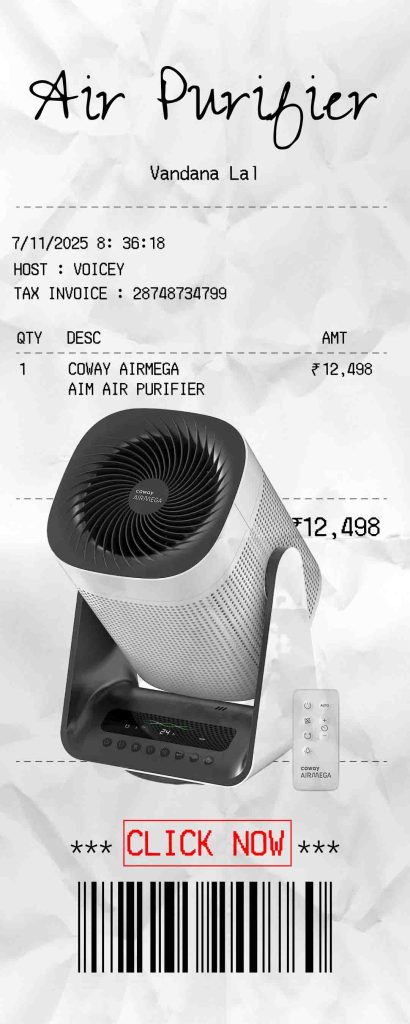
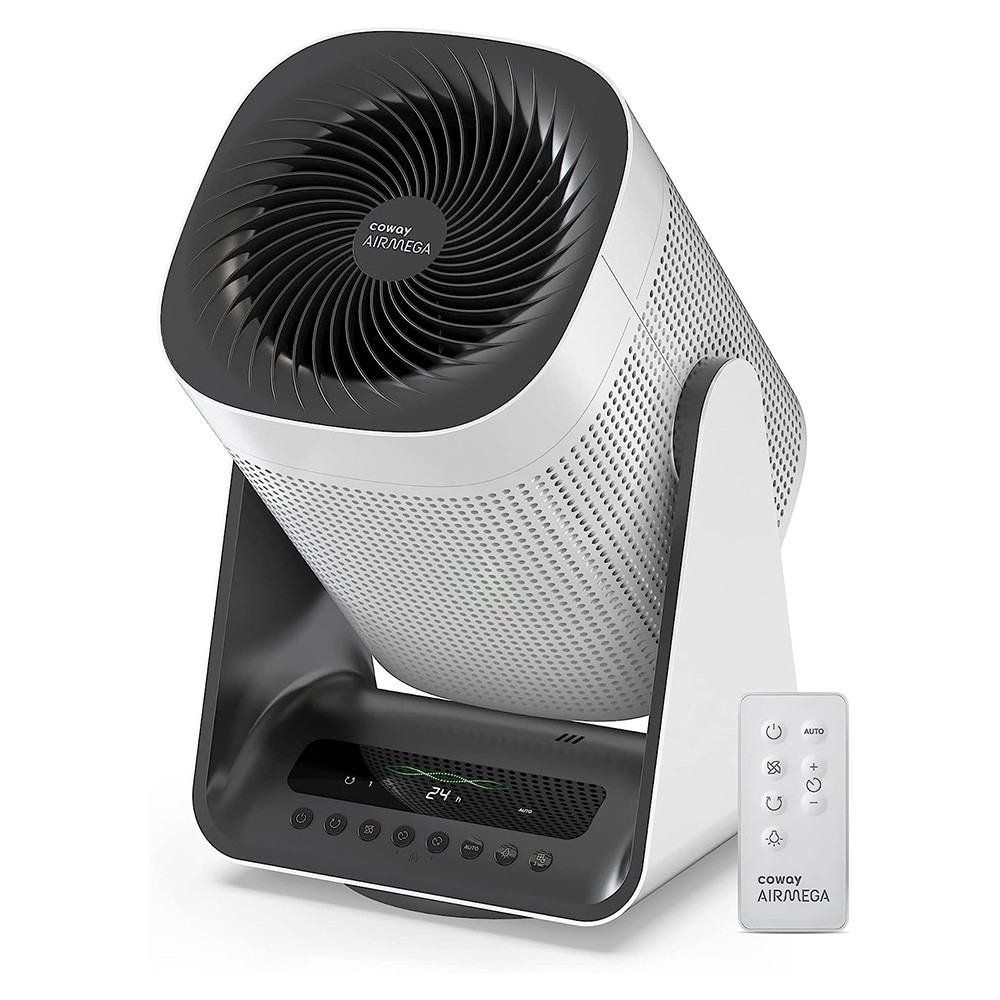
So I bought a Coway Airmega AIM for ₹12,498. My invoice is dated 24 November 2025. I bought it with my own money. Coway had no involvement in this review.
Nearly a year later, I know what it is like to live with. Whether I properly tested its most important promise is another question.
One Room Is Not the Whole House
My home is a 1,050 sq ft apartment with two bedrooms, a hall, and a study. Coway lists the Airmega AIM for rooms up to 355 sq ft. That made it a purchase for one room, not a solution for the entire flat.
I could move it around, but I mostly used it in my bedroom, with the door closed, for roughly 12 hours a day on Auto mode. The seven-year motor warranty stated on my invoice was part of the appeal. The important word is motor: that is not seven years of cover for everything inside the appliance.
That is the setup behind this review: one household, ordinary use, and no independent particle measurements.
Week One: Red, Orange, Reassurance
Setup was straightforward. I removed the protective packaging around the filter, registered the warranty, and plugged it in.
The purifier was compact enough not to dominate the room. I liked being able to adjust the fan’s direction instead of having it blow straight into my face. The remote was convenient too.
Then came the part I had been waiting for.
With the bedroom door closed and Auto mode switched on, the indicator showed red. About ten minutes later, it changed to orange, then green. The fan became quieter. I walked past it, and the light briefly returned to orange before settling back to green.
I assumed I had disturbed some dust. I didn’t measure what had happened.
But the colour change was reassuring. I had spent ₹12,498 on something I couldn’t see, and here was a light telling me something was changing.
It felt like proof.
What the Green Light Couldn’t Tell Me
The indicator was information from the purifier’s own sensor. It wasn’t independent verification of the room’s air quality. I didn’t have a separate particle monitor. I didn’t record readings before switching the machine on, compare them over several days, or check what happened overnight.
The light changed. What I couldn’t tell was how much particle pollution remained, or whether the improvement held.
Filtration claims need the same distinction.
The US Environmental Protection Agency’s explanation of HEPA filters describes theoretical capture of at least 99.97% of particles measuring 0.3 microns. That describes filter efficiency, not a guarantee that my bedroom becomes 99.97% pollution-free.
For choosing a purifier, the EPA’s guide to air cleaners in the home recommends matching clean air delivery rate, or CADR, to room size. It also distinguishes particle filtration from gas removal: no air cleaner eliminates every indoor pollutant.
None of this means my purifier wasn’t working. It means I didn’t independently establish how well it was working.
Less satisfying than watching a light turn green, admittedly. More honest, though.
The Honeymoon Ended at Night
During the day, the fan noise didn’t bother me much. I could work with it running.
At night, things were different.
In Auto mode, it sometimes suddenly got louder. That woke me more than once, and the first few times I genuinely wondered what had happened. A machine announcing itself in a dark bedroom is not my preferred sleep soundtrack. Once it quietened down, I was usually fine. But if changes in background noise disturb your sleep, this is worth considering. It wasn’t constantly loud in my experience. The volume changes were the irritating part.
₹12,498 Was the Entry Price
Our electricity bill didn’t rise noticeably after we started using it. But I didn’t measure its consumption separately, so I can’t give you a reliable running-cost figure.
The filter was the more obvious ownership expense.
I replaced it after roughly six months, when I noticed a musty smell and found it visibly dirty. A local shop charged me ₹1,800 for the replacement.
The replacement brought my recorded appliance-and-filter spending to ₹14,298, excluding electricity. But I hadn’t established exactly what I was buying. I trusted the shop and felt the machine was working as before. I didn’t verify the replacement’s origin or test its filtration performance.
Fitting inside the machine is not the same thing as independently demonstrating equivalent performance.
I wouldn’t turn that purchase into advice to buy whichever compatible filter costs less. Before buying again, I would check the price and availability of the manufacturer-specified replacement, not just the appliance.
What I Can Actually Tell You
| Area | What I observed | What I didn’t establish |
| Setup and convenience | Easy to set up, move, and control | Suitability for every room |
| Air-quality indicator | Changed from red to green during use | Independently verified particle levels |
| Noise | Generally unobtrusive while working; sudden increases sometimes woke me | Measured sound levels |
| Electricity | No noticeable change in our household bill | The purifier’s separate electricity cost |
| Filter replacement | Paid ₹1,800 after roughly six months | Equivalence to the original filter |
| Symptoms | Fewer sore-throat mornings | Whether the purifier caused that change |
So, Was it Worth it?
It fit into my bedroom, was easy to operate, and became something I used regularly. The occasional noisy night irritated me. The replacement filter added a cost I hadn’t properly considered. If I were shopping again, I would pay more attention to published performance information, room suitability, and replacement costs. I would also be clearer about the difference between finding a product reassuring and independently verifying its results.
I stopped waking up with a sore throat as often. I can’t tell you whether the purifier caused that change. I can tell you why I kept switching it on.